Cart is empty
To cart page

Cart is empty
The President of the State of Israel and Dr. Miriam Adelson took part in a first-of-its-kind tour of the Pilgrims’ Road at the City of David, Jerusalem’s main thoroughfare from the Second Temple period, which has now been fully uncovered and opened to the general public for the first time in approximately 2,000 years.
The tour marked the completion of one of the most significant archaeological flagship projects undertaken in Israel in recent years, as well as the opening of a central historic artery in the heart of Ancient Jerusalem.
As President of the State of Israel, Mr. Isaac Herzog, said, “We are standing here at the entrance to the road that once led pilgrims into Jerusalem, to the Temple Mount and the Western Wall. It is deeply moving to witness the impressive work being carried out here at the City of David. I wish to thank all those involved for their extraordinary efforts, and to extend special thanks to Dr. Miriam Adelson for her meaningful support in bringing to life this historic narrative that connects us to a heritage two millennia old.”
Dr. Miriam Adelson said: “As we mark five years since the passing of my husband, Sheldon Adelson of blessed memory, this moment holds special significance for me. For many years, Sheldon and I regarded the uncovering of Jerusalem’s past and making its historic landscape accessible to the wider public as a public and moral mission. Our long-standing partnership with the City of David made it possible to advance initiatives of national importance, foremost among them the uncovering of the Pilgrims’ Road and its opening to the public. The opening of the road today represents a living connection between the heritage of the past and the present, and I invite the general public to come, visit, and walk this historic path, revealed for the first time in generations”.

Referring to the opening of the road to the public, David Be’eri, CEO of the City of David, said:
“During the Second Temple period, the Pilgrims’ Road connected tens of thousands of people who came from across the land and the world on their way to the Temple. Today, it will once again connect millions of visitors and tourists who will walk upon these very same stones. The presence of the President of the State of Israel and Dr. Miriam Adelson underscores the national and historical significance of this site, and the connection between the heritage of the past, and the Israeli public and visitors arriving in Jerusalem today.”
Harel Ben-Shahar, Central District Director at the Israel Nature and Parks Authority, added: “We welcome the opening of the Pilgrims’ Road and invite the general public to visit the national park and walk the same paths and stones once trodden by our ancestors in ancient times. We thank the City of David for successfully exposing this important street to the many visitors who come to the park from all corners of the world.”
Deep underground, below the surface of modern-day Jerusalem, one of the city’s most remarkable archaeological discoveries has been uncovered in recent years: the Pilgrims’ Road at the City of David, the main street of Jerusalem during the Second Temple period. Located at the heart of the Jerusalem Walls National Park, the road allows visitors, for the first time in nearly 2,000 years, to walk on the original paving stones once trodden by the city’s residents and by pilgrims on their way to the Temple.
This was a central thoroughfare that led from the Pool of Siloam in the southern part of the city to the Temple Mount area, serving as a major artery of movement in ancient Jerusalem. Local residents, merchants, visitors, and pilgrims passed along this route, arriving in Jerusalem from across the land and from around the world. It was a vibrant urban street where daily life unfolded, with the constant flow of people, commerce, services, and human interaction, and was an integral part of the fabric of the city during the Second Temple era.
The exposure of the street began with an unexpected event in 2004, when a burst infrastructure pipe led to the rediscovery of the Pool of Siloam in the City of David. What initially appeared to be a technical mishap became the catalyst for a flagship project led by the Company for the Reconstruction and Development of the Jewish Quarter and the Israel Antiquities Authority, which led to the start of the excavation of the street, one of the most complex archaeological digs ever conducted in Israel. Carried out under exceptionally challenging engineering conditions and beneath a living city, the excavations revealed an entire street preserved in extraordinary condition.
The street stretches approximately 600 meters in length and averages about 8 meters in width, expanding significantly in its southern section. Managed by the Israel Antiquities Authority as a national archaeological flagship project, the excavation uncovered broad stone paving slabs, well-constructed drainage channels, and numerous artifacts found in situ, including coins, weights, and everyday objects. Together, these discoveries make it possible to reconstruct the character of the street as a lively urban space, where daily commerce, small services, and human encounters took place throughout the day.
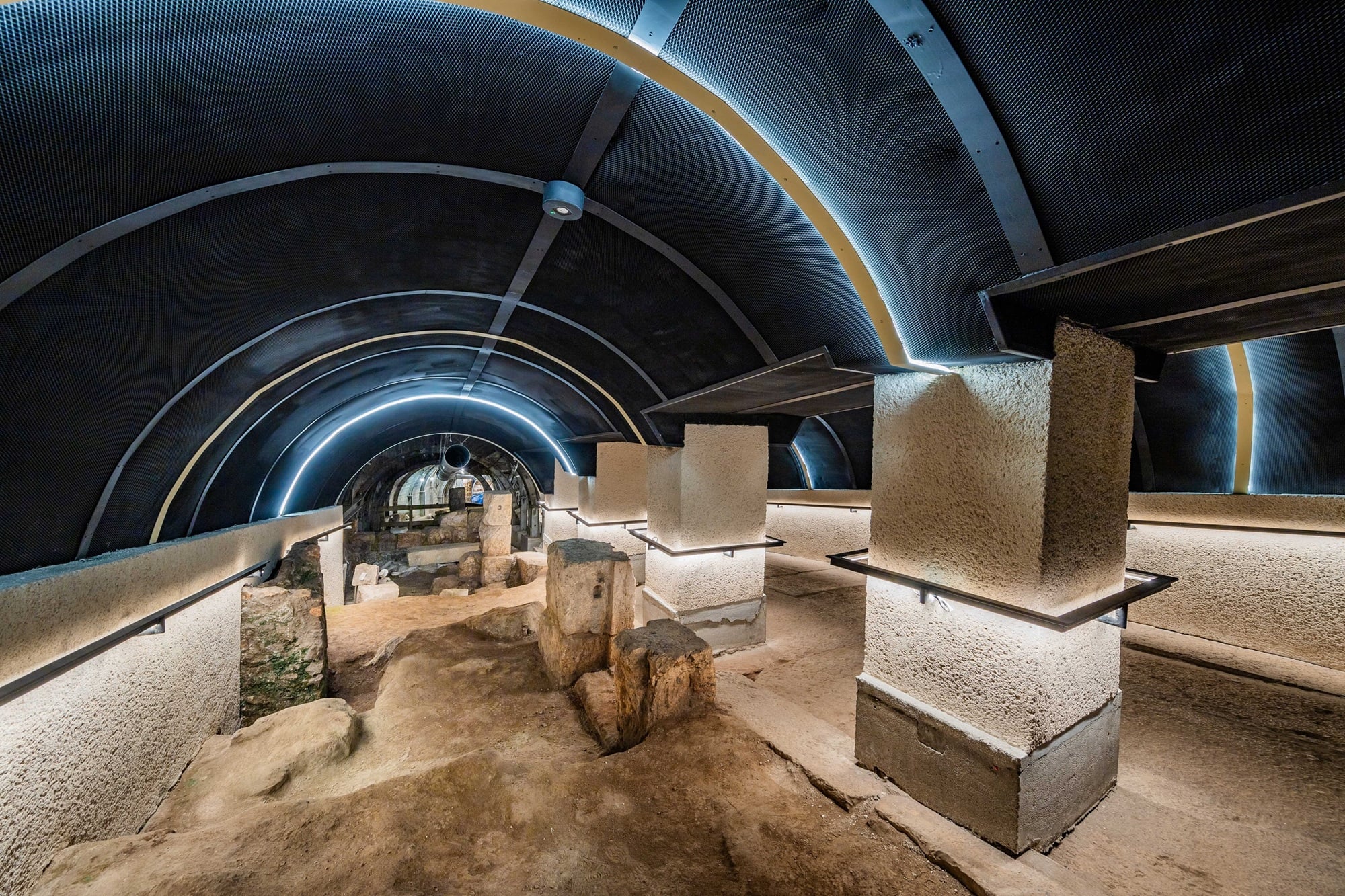
More than just a functional passageway to the Temple, the street was a central urban artery at the very heart of city life. The direct connection between the Pool of Siloam and the Temple illustrates how religious practice, economic activity, and civic life were interwoven within a single urban space. Pilgrims making their way to the Temple passed through a vibrant, active street, an integral part of the city, not along a route detached from everyday urban life.
One of the most striking aspects of the Pilgrims’ Road is the manner in which it has been preserved. The street has not been reconstructed or redesigned. It was uncovered exactly as it was, abandoned suddenly and left untouched. Archaeological evidence indicates that its use came to an abrupt end around the time of the Great Revolt, when the rhythms of urban life ceased and the entire area was deserted. Since then, the street remained buried beneath layers of earth for about two millennia. The tour of the Pilgrims’ Road begins with an overlook of Ancient Jerusalem, continues with a descent to the area of the Pool of Siloam, and proceeds with an underground walk along the length of the street. The route concludes at the Davidson Archaeological Park, managed by the Company for the Reconstruction and Development of the Jewish Quarter. This journey allows visitors to walk among the original paving stones and in situ finds, gaining a tangible understanding of Jerusalem at its height—through the very spaces in which its residents and visitors lived, worked, and walked.
The Pilgrims’ Road offers a complete guided route along the ancient street. The tour lasts approximately two hours and is suitable for families with children, adults, and organized groups. Its opening enables visitors to walk a street that lay hidden underground for thousands of years and to encounter Jerusalem as it once was—a living, dynamic, and bustling city, revealed directly through its authentic remains, without reconstruction.


Is anyone here?
Since no action was taken for a while, an automatic logout will occur in 03:00 minutes.

