
Cart is empty
To cart page
Cart is empty


New! Your personal account
Here you can update and cancel orders, manage your profile, and redeem coupons all in one place. Sign up quickly to get: 10% off your next purchase!
The excavation has been conducted in recent years by the Israel Antiquities Authority in cooperation with the City of David Foundation and the Company for the Restoration and Development of the Jewish Quarter. The find was discovered in the Davidson Archaeological Park of Jerusalem. Only one other ancient lead pendant bearing the Menorah symbol is known in the world
The pendant will be displayed to the public as part of Heritage Week events at the Jay and Jeanie Schottenstein National Campus for the Archaeology of Israel in Jerusalem.
How did an ancient pendant made of cast lead, decorated on both sides with a seven-branched menorah, come to Jerusalem at a time when Jewish presence in the city was restricted?
A very rare personal necklace pendant from the 6th – early 7th centuries CE (Late Byzantine period) was recently discovered in a large-scale archaeological excavation in the Davidson Archaeological Park of Jerusalem, conducted by the Israel Antiquities Authority in cooperation with the City of David Foundation and the Company for the Reconstruction and Development of the Jewish Quarter. The rare find is decorated on both sides with an identical image of a seven-branched menorah and was apparently worn by a Jew who arrived in Jerusalem during the Byzantine period, when Jews were prohibited from entering the city.
“One day while I was digging inside an ancient structure, I suddenly saw something different, gray, among the stones”, says Ayayu Belete, a City of David worker. “I picked up the object out and saw that it was a pendant with a menorah on it. I immediately showed the find to Esther Rakow-Mellet, the area director, and she said it was an especially rare find. I was deeply moved and excited!”
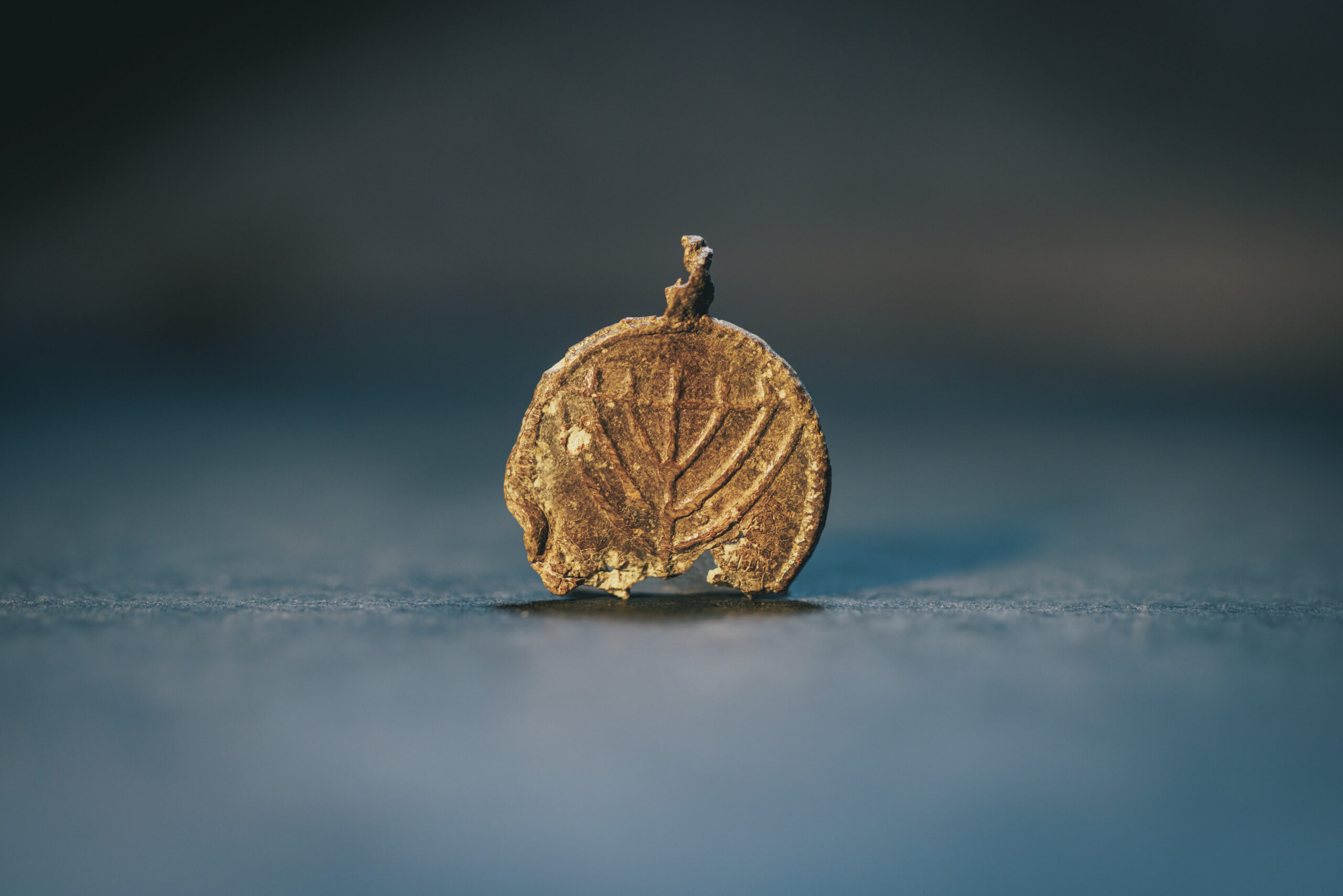
The object bearing the menorah decoration was discovered within a layer of rubble, inside a Late Byzantine period building (6th–early 7th centuries). This structure, together with the remains of other contemporaneous buildings, was subsequently buried beneath an 8 meters thick layer of fill, entirely covering all architectural elements from the Late Byzantine period. This thick layer of fill was piled up in the area as part of the construction activities associated with the erection of monumental Umayyad structures in this part of the city of Jerusalem at the beginning of the 8th century.
The pendant was designed as a disk with a loop at the top, most likely intended to be worn on a necklace. Both sides of the pendant depict a seven-branched menorah, highlighted by a circular frame. One side was well-preserved, while the other was covered with patina, a natural layer of weathering. Each menorah design displays three arms on either side of the central shaft. At the top of each arm is a horizontal crossbar, with flames rising above it. An XRF test conducted at the Israel Antiquities Authority’s analytical laboratories and performed by artifact conservator Ilya Reznitsky found that the pendant contains approximately 99% lead.
According to Dr. Yuval Baruch, Dr. Filip Vukosavović, Esther Rakow-Mellet and Dr. Shulamit Terem, Researchers at the Israel Antiquities Authority:
“A pendant made of pure lead, decorated with a menorah, is an exceptionally rare find. Research has identified pendants of glass and other metals decorated with a menorah, but we know of only one other pendant in the world bearing the symbol of the menorah, made of lead. That pendant, of unknown origin, is housed in The Walters Art Museum in Baltimore, USA. The double appearance of the menorah on each side of the disc indicates the deep significance of this symbol, and the central place of the menorah in the visual expression of connection to the Temple and its memory, even in periods long after the destruction of the Temple.”
Historical sources indicate that during the Byzantine period, Jews were prohibited from entering Jerusalem. This fact makes it difficult to understand the significance of the finds decorated with the menorah symbol in their historical context: Are these random finds? Were they private objects of Jews who came to the city for various reasons—perhaps merchants, or those on administrative missions, or individuals who came to the city as secret pilgrims, and under unofficial circumstances?


Dr. Yuval Baruch of the Israel Antiquities Authority, who has been directing the excavations at this site for about a quarter-century, and who studies the subject of menorahs, said:
“This is an unusual find. This pendant, bearing the symbol of the menorah, is not just a material object; it is a personal seal, an emblem of memory and identity, which probably belonged to an anonymous Jew who chose to wear it around his or her neck. This choice is not only the essence of a personal commitment to one’s religious faith, and perhaps even an expectation of that unanimously recognized person who held the artifact for national revival, but it also attests that during periods when imperial edicts were issued prohibiting Jews from residing in the city, they did not stop coming there! It can be further surmised that the choice to use lead, rather than one of the more common metals for making jewelry, suggests that the owner of the object wore it as an amulet, not jewelry. There is a strong basis to this contention, because lead was considered a common and particularly popular material for making amulets at that time.” Baruch emphasizes, “During the Byzantine period the menorah became a symbol of national memory, and it expressed the expectation of national revival among the Jewish communities in the Land of Israel; in the Diaspora, they adopted it in exactly the same way. Moreover, in recent years, there is increased archaeological evidence that show that Jews, despite all the prohibitions and difficulties imposed on them, found the ways to reach Jerusalem – and it is possible that there were even some who settled there.”
Israeli Minister of Heritage, Rabbi Amichai Eliyahu, summarizes:
“The exciting find of the menorah pendant joins a series of testimonies that continue to be discovered in Jerusalem, and that tell the story of the continuity and devotion of the Jewish people in the city. Even during periods when Jews were prohibited from entering Jerusalem, the connection to this holy place did not cease. I invite the public to see and get impressed by this rare find as part of the Heritage Week events led by the Ministry of Heritage during the Hanukkah holiday.”
The rare menorah pendant will be presented to the public for the first time during Hanukkah, as part of family tours and activities taking place at the Jay and Jeanie Schottenstein National Campus for the Archaeology of Israel in Jerusalem.
Details are available on the Israel Antiquities Authority website.


Is anyone here?
Since no action was taken for a while, an automatic logout will occur in 03:00 minutes.

